This week I took some time away from work on my collection to answer a reference question. The question was actually composed of ten questions: each a query of some sort in regards to a former faculty member at the University. The information required ranged from a single item, such as date of birth, to full biographical information. While this may seem a daunting task, the Archives has developed a wonderful faculty catalog for just such reference information. Faculty members each have a curriculum vitae listing basic background information and any important information relevant to their work at IU. In some cases a second file exists which includes newspaper clippings or other some newsworthy publications.
Therefore, to properly answer the reference query, I went through the emailed list of names and found the appropriate CV, and if available, file folder of other information. The faculty files included all the information requested and then some! The Archives have a wealth of resources available in order to aid researchers of all kinds. Preparation allows for reference work to be interesting and fulfilling rather than stressful. In this case I was able to answer the question and correspond with the researcher, all within a matter of hours. The handful of reference questions I have answered thus far have been enjoyable, and I like aiding in disseminating information.
Thursday, October 28, 2010

Tuesday, October 19, 2010
Where Art Thou, Efficiency?
I began to put my processing plan into action last week. After surveying the collection, I believe the entirety of the materials can be arranged into six series, with assorted sub-series throughout. Since a great deal of audio-visual material is embedded among research notes and publications, I considered creating a seventh series solely for audio-visual; however, I ultimately chose to leave the materials listed with associated research. The six series are very broad as to encompass as much material as possible: academic life, publications, professional organizations, other works and projects, general correspondence, and finally, personal life. Of course the names of those series are subject to change. In any case, I chose to take my container lists and began slotting folders into proper series and sub-series. I did find a few instances where I either needed to completely change, add, or subtract a sub-series. I was pleased to find most of materials easily fit into my arrangement scheme.
Comparing my notes from my first day to today was an eye-opening experience. My notes at the beginning are vaguer; in fact, a few are completely unhelpful in retrospect. I find this a bit frustrating, as I pride myself on my detail-oriented nature, but I can understand the reasons behind it. As I began my internship, I did not have the knowledge of what specific details were most helpful. Secondly, I did not know the scope and content of the collection as a whole; consequently, I did not note potential series or sub-series as readily early on. In the future I believe I should take more care to note possible series, even if I scrap them later. The more detail, the better. Conversely, my notes from last week are precise, with folders arranged in my notes as I listed them. My ability to recognize folder relationships streamlined the arrangement process, at least on paper! I believe the next go-round with a collection will be much less stressful and certainly more efficient.
Comparing my notes from my first day to today was an eye-opening experience. My notes at the beginning are vaguer; in fact, a few are completely unhelpful in retrospect. I find this a bit frustrating, as I pride myself on my detail-oriented nature, but I can understand the reasons behind it. As I began my internship, I did not have the knowledge of what specific details were most helpful. Secondly, I did not know the scope and content of the collection as a whole; consequently, I did not note potential series or sub-series as readily early on. In the future I believe I should take more care to note possible series, even if I scrap them later. The more detail, the better. Conversely, my notes from last week are precise, with folders arranged in my notes as I listed them. My ability to recognize folder relationships streamlined the arrangement process, at least on paper! I believe the next go-round with a collection will be much less stressful and certainly more efficient.
Thursday, October 7, 2010
Accessions
This week I had the opportunity to learn about the accession process. Several boxes of materials from a former IU faculty member came in over the weekend; about half contained loose papers in old beaten-up boxes and the remainder was found in old letter boxes. I should mention an accession material in the custody of the archive but not yet processed with a complete finding aid made available to the public. My job was to ascertain the contents of the new accession, note the various folders (where present), form some kind of organization, and re-box the papers into our standard archival boxes. Few things are more horrific than a pile of papers lying haphazardly in a dusty box, yet little-by-little I was able to find a system, and thankfully some jumbled notes in the piles of papers. However, before I could re-box, I first had to learn how to build a box. This was initially harder than it looked. Yet after being told not once, but twice, how to construct an archival box, I discovered I had a knack for box-building. I labeled each box with its number in the sequence. Sixteen boxes later, I completed my organization scheme and made extensive notes on the papers within each box.
Following re-boxing, I learned the procedure for assigning accession numbers to newly-arrived records. Each new accession is assigned a number based on the current year as well as the current number of accessions in that year. This was the 89th new accession of the year 2010; hence, the accession number for this group is 2010/089. This number is critical for tracking unprocessed records. The date, accession number, creator, number of containers (in this case boxes), and initials of the processor are recorded for reference. The next step was to enter the data collected during my initial survey of the records. The Indiana University Archives utilized an internal database to track accessions. The database is not made available to the public. The Archives accession database system is a program named askSam, which allows for basic information entry in regards to accession number, creator, date ranges, and department of origin. After this vital information, the next critical step is to enter the list of materials within each box. Entering this information allows the Archives to have an electronic record available to quickly search if necessary in case a relevant research question comes in prior to actual processing.
The final step is the preparation of the boxes for long-term storage. Due to the vast number of materials in the archive, new accessions are sent to the ALF for storage until the determination is made to process. In order to facilitate quick and easy retrieval of these accessions, each box is assigned labels. The accession number is written on each box and a barcode is attached. These barcodes are entered into a database with the accession number and box number. Finally, each box is secured with a plastic band. At last the accession is complete and ready to be stored for processing at a later date.
So I helped accession a new group of records. I always enjoy learning new things, so this was a fun process. I learned some skills I will use for a long time and explored another aspect of the Indiana University Archives. Finally, a quick tip for all future archival subjects: when you donate your materials, please organize it neatly; it makes everything better!
Following re-boxing, I learned the procedure for assigning accession numbers to newly-arrived records. Each new accession is assigned a number based on the current year as well as the current number of accessions in that year. This was the 89th new accession of the year 2010; hence, the accession number for this group is 2010/089. This number is critical for tracking unprocessed records. The date, accession number, creator, number of containers (in this case boxes), and initials of the processor are recorded for reference. The next step was to enter the data collected during my initial survey of the records. The Indiana University Archives utilized an internal database to track accessions. The database is not made available to the public. The Archives accession database system is a program named askSam, which allows for basic information entry in regards to accession number, creator, date ranges, and department of origin. After this vital information, the next critical step is to enter the list of materials within each box. Entering this information allows the Archives to have an electronic record available to quickly search if necessary in case a relevant research question comes in prior to actual processing.
The final step is the preparation of the boxes for long-term storage. Due to the vast number of materials in the archive, new accessions are sent to the ALF for storage until the determination is made to process. In order to facilitate quick and easy retrieval of these accessions, each box is assigned labels. The accession number is written on each box and a barcode is attached. These barcodes are entered into a database with the accession number and box number. Finally, each box is secured with a plastic band. At last the accession is complete and ready to be stored for processing at a later date.
So I helped accession a new group of records. I always enjoy learning new things, so this was a fun process. I learned some skills I will use for a long time and explored another aspect of the Indiana University Archives. Finally, a quick tip for all future archival subjects: when you donate your materials, please organize it neatly; it makes everything better!
Saturday, October 2, 2010
Creating A Plan
I continued to survey the Nugent collection this week, progressing more quickly through the remaining accessions. I believe I have ascertained the series and associated sub-series spanning the entirety of the collection. The larger challenge lies in creating a comprehensive, or as comprehensive as possible, processing and management plan for the collection. There are multiple considerations, including: managing various time restrictions within and across series, removing files made by a secondary creator to another collection, and determining which materials are not long-term preservation material. One issue concerns vast amounts of financial information (bills, receipts, etc.) is intermixed with correspondence; should the time be taken to go through each folder item-by-item to remove these documents or should the collection stay as-is? These considerations are not uncommon and I will meet them again time and time again throughout my future career. However, this is my first go-round. I look forward to completing my first proposed plan in the next week and submit it for review. I'm certain I will have overlooked something or made a rookie mistake but it's part of the learning process.
Tuesday, September 21, 2010
Reading Response One: Macro-Appraisal and Social Value
For my first reading response, I chose to read "Macro-appraisal and Functional Analysis: documenting governance rather than government" by well-known Canadian archivist Terry Cook. I wanted to assess an article that focused on appraisal methodology and the role of the archivist plays in the processing of collections. I am more familiar with appraisal, which deals with specific records, than macro-appraisal, which is done at the collection level. So this article is both informative and answers some of my questions regarding the impact of archivists themselves in appraisal decisions. Although not expressly intended or consciously undertaken, archivists do assume some role, small or large, in the creation process of archival collections.
Societal structure and functions of citizens imbue records with their importance. Correspondingly, archivists act, in some way, as co-creators of collections by choosing those materials to archive and those to destroy. As the records creation process is invariably a result of the iterations and movements of a functioning society, the role of the archivist as the final determining factor in the social memory must be as objective as possible. The archivist is charged with appraising, processing, arranging, and preserving the functional memory of government, business, university, etc.; this is done by understanding the provenance and relevance of materials. Whether top-down macro-appraisal or bottom-up appraisal is better is difficult to ascertain; in any case, those materials selected for the archives will tell the tale for future researchers.
Though the title of the article indicates a government-central theme, the actual content is applicable to a wide variety of businesses. The main goals of an archivist, no matter the collection or its provenance, is to appraise the materials and leave with only the "best records" remaining. Cook believes this is possible using the top-down approach of macro-appraisal and functional analysis. The most intriguing aspects of the article focused upon the role social values and norms play in the record creation and appraisal process. Cook states the work done by individuals interacting with or within the government (for example) has dramatic influence not only on the types of records created through said interaction but then again influence what records are appraised as archive-worthy. In each case the values of the citizens interacting with the institution impress their current beliefs into and upon the acts recorded and maintained for posterity. These social norms are visible through the functions created, maintained, or eliminated as time passes. As Cook states, "The principal focus is on civil governance and citizen-state interaction, not on documenting the functions of government." The article can be interpreted differently by each reader, much like one appraising a collection for those "best records."
Terry Cook, “Macroappraisal and Functional Analysis: documenting governance rather than government,” Journal of the Society of Archivists 25, no. 1 (2004): 5-18.
Societal structure and functions of citizens imbue records with their importance. Correspondingly, archivists act, in some way, as co-creators of collections by choosing those materials to archive and those to destroy. As the records creation process is invariably a result of the iterations and movements of a functioning society, the role of the archivist as the final determining factor in the social memory must be as objective as possible. The archivist is charged with appraising, processing, arranging, and preserving the functional memory of government, business, university, etc.; this is done by understanding the provenance and relevance of materials. Whether top-down macro-appraisal or bottom-up appraisal is better is difficult to ascertain; in any case, those materials selected for the archives will tell the tale for future researchers.
Though the title of the article indicates a government-central theme, the actual content is applicable to a wide variety of businesses. The main goals of an archivist, no matter the collection or its provenance, is to appraise the materials and leave with only the "best records" remaining. Cook believes this is possible using the top-down approach of macro-appraisal and functional analysis. The most intriguing aspects of the article focused upon the role social values and norms play in the record creation and appraisal process. Cook states the work done by individuals interacting with or within the government (for example) has dramatic influence not only on the types of records created through said interaction but then again influence what records are appraised as archive-worthy. In each case the values of the citizens interacting with the institution impress their current beliefs into and upon the acts recorded and maintained for posterity. These social norms are visible through the functions created, maintained, or eliminated as time passes. As Cook states, "The principal focus is on civil governance and citizen-state interaction, not on documenting the functions of government." The article can be interpreted differently by each reader, much like one appraising a collection for those "best records."
Terry Cook, “Macroappraisal and Functional Analysis: documenting governance rather than government,” Journal of the Society of Archivists 25, no. 1 (2004): 5-18.
Monday, September 20, 2010
Hollinger Metal Mail, Fellow Interns
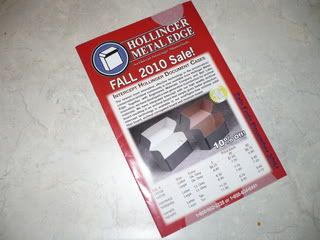
Earlier this week I arrived home to find a surprise in my mail. I will admit to some excitement as I opened my first-ever personally-addressed flier from archival supply company Hollinger Metal Edge:

Certainly the marketing department at Hollinger is to be commended for their efforts! This graduate student finds it all quite fascinating.
In other news, I want to take time to recognize my internship colleagues this semester. I have included links to their blogs on the right side of my site. Friends and aspiring archivists Mike Szajewski and Amanda Hunt are each interning in the University Archives. My dear friend Brenna Bychowski is interning at IU's Lilly Library, an excellent rare books and special collections repository, this fall. Brenna is not in the archival program but offers interesting insights into specialized collections activities. Please take the time to visit their blogs this fall!
Certainly the marketing department at Hollinger is to be commended for their efforts! This graduate student finds it all quite fascinating.
In other news, I want to take time to recognize my internship colleagues this semester. I have included links to their blogs on the right side of my site. Friends and aspiring archivists Mike Szajewski and Amanda Hunt are each interning in the University Archives. My dear friend Brenna Bychowski is interning at IU's Lilly Library, an excellent rare books and special collections repository, this fall. Brenna is not in the archival program but offers interesting insights into specialized collections activities. Please take the time to visit their blogs this fall!
Saturday, September 18, 2010
Boxes and More Boxes
I ended week two of my internship feeling cautiously optimistic I would be able to finalize a processing plan and perhaps, with a bit of skill and beginner's luck, begin to work processing the Nugent collection this week. However, somewhere along the way last week I underestimated the sheer amount of materials still waiting to be surveyed. Along with the 34 boxes in the initial accession I have surveyed, there are a handful of other accessions that add up to 31 more boxes of materials. The other accessions have been stored at the Auxiliary Library Facility, or ALF, a specially-designed off-campus building with humidity and temperature controls for preservation purposes. The Indiana University Archives, as well as University Libraries, recall items from the ALF when needed. Imagine everyone's excitement in the Archives this week when I asked to recall another 31 boxes! These other accessions have been previously analyzed by others. However, I believe I should take the time to open each and take a look myself. Each time I open a box and take notes as to its contents, I develop a better idea of the scope and arrangement of the overall collection. As this week ends, I can claim progress as well as renewed humility. Certainly there are more series and sub-series for me to discover in the Nugent collection.
As I survey the nearly half-century of materials in the Nugent papers, I am reminded of the sheer amount of paperwork, correspondence, and memorabilia each of us accumulates during our lives. Of course, today the concept of "correspondence" has largely entered the digital realm; my generation may be the last to recall sitting down to write a letter by hand. Those younger do not associate letter composition with pen, paper and postage. The information age has made correspondence easier but has unintentionally removed this long-standing aspect of social history, as least conceptually. Socially email is a better, faster, more efficient means of communication, and archivists and records managers will have to continue to be creative in developing preservation techniques. Imagine if each email, of any type of relevance, was printed. For most of us, that would mean mountains of material. One look around the archives today and a few mountains may be visible here and there; I do ponder what an archive will look like in ten, twenty, fifty years. What types correspondence will exist for those in another half-century, and what new challenges await future archivists like myself during that time?
As I survey the nearly half-century of materials in the Nugent papers, I am reminded of the sheer amount of paperwork, correspondence, and memorabilia each of us accumulates during our lives. Of course, today the concept of "correspondence" has largely entered the digital realm; my generation may be the last to recall sitting down to write a letter by hand. Those younger do not associate letter composition with pen, paper and postage. The information age has made correspondence easier but has unintentionally removed this long-standing aspect of social history, as least conceptually. Socially email is a better, faster, more efficient means of communication, and archivists and records managers will have to continue to be creative in developing preservation techniques. Imagine if each email, of any type of relevance, was printed. For most of us, that would mean mountains of material. One look around the archives today and a few mountains may be visible here and there; I do ponder what an archive will look like in ten, twenty, fifty years. What types correspondence will exist for those in another half-century, and what new challenges await future archivists like myself during that time?
Subscribe to:
Posts (Atom)